About Us
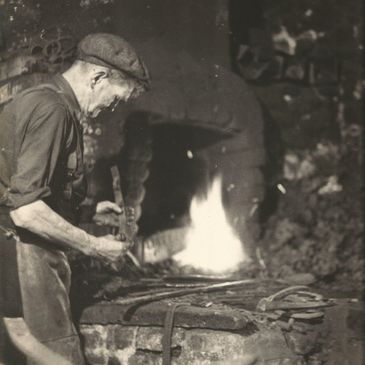
Fred (Noah) Liddiard
Fred (Noah) Liddiard
Fred (Noah) Liddiard
1900 - 1946
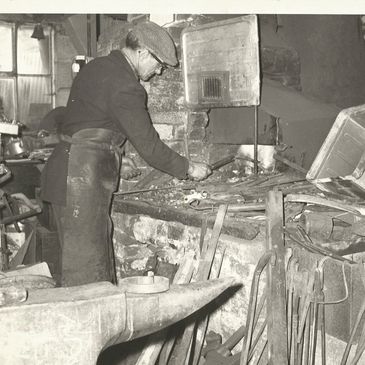
Alan Liddiard
Fred (Noah) Liddiard
Fred (Noah) Liddiard
1946 - 1982

Marc Hart
Fred (Noah) Liddiard
Marc Hart
2012 - present
The Old Forge

Marc Hart
The Old Forge in Aldbourne has been the site of a village Blacksmith for three generations in the same family. Marc Hart, the current owner has overseen the restoration and re-opening of the forge that was previously his Great Uncles and Great Grandfathers before him.
When Alan Liddiard (Marc's Great Uncle) died suddenly in 1982 the forge doors were closed and the site left untouched for almost 30 years.
Marc was asked to re- open the forge for the Aldbourne Festival in 2010. In 2012 the Old Forge and its site, underwent a sympathetic restoration and is now operating as a working traditional Blacksmiths once more as "The Alan Liddiard Forge".

Alan Liddiard
Alan Liddiard was born and bred in the village, the son of the late Noah Liddiard. He came to work full time at the forge in 1946 following war service with the Royal Artillery, seeing service in France, Belgium, Holland and Germany. While he was stationed at Sandringham his unit received regular visits from the King and Queen. He was commissioned to produce a Fire-Screen for the Queen Mother in 1976. Alan believed the forge had been used for over 200 years. The deeds of his house next door trace the various occupiers back as far as the reign of Charles II (1660-1685).
Fred (Noah) Liddiard
Apprentice to Fred Barnes at the turn of the 20th Century. He took over the business in 1913 when he is reported to have shod the last oxen in the village. Much of Noah's work came from shoeing horses, and repairing agricultural machinery. A regular task would have been the bonding of cart wheels made by the village carpenter. The bonding plate is still visible in the yard, and many of the horseshoes can be seen hanging from the beams in the forge. He carried on the business until his son, Alan, took over the forge in 1946.